Thursday, March 29, 2012
Diana Raj Kumari Photography: On a tightrope
Diana Raj Kumari Photography: On a tightrope: "Sometimes one has got to balance oneself on a tightrope while the flow of life rushes by." *** Diana Raj Kumari Photogr...


Wednesday, March 28, 2012
Diana Raj Kumari Photography: Together ♥♥
Diana Raj Kumari Photography: Together ♥♥: Together in love, everything else fades leaving only their hearts to beat together as one.. ♥♥ *** Diana Raj Kumar...
Thursday, March 22, 2012
Diana Raj Kumari Photography: What is in your bag??
Diana Raj Kumari Photography: What is in your bag??: What is in your bag today?? Anything interesting and worth buying..?? Here....you check out and see for yourself what you want......
The Male Indian Koel(Kokil) Bird

These melodious bird Koel/Cuckoo or Kokil in Manipuri is a long and slim bird, 39- 46 cm in length. Has a long tails, pointed wings and curved bills. The male is glistening blueish black, with yellowish green bill and crimson eyes. They have short wings but long tail. The female is dark brown, with profusely spotted and barred with white. Females have green beak and red eyes. Males and females are distinct in appearance. Tail is dark gray and slightly white in colour. The crown is dark brown and the bill is pale green in colour. Females are slightly smaller than the males. It is brood parasite, and lays its single egg in the nests of a variety of birds, including Jungle Crow and House Crow.
Kingdom : Animalia
Phylum : Chordata
Class: Aves
Order : Cuculifomes
Family : Cuculidae
Zoological name : Eudynamys scolopacea
Found In : They are mostly found in every part of India. They can also be spotted in the Batla National Park, Corbett National Park, Sultanpur Bird Sanctuary, Pench National Park and Barwala Bird Sanctuary. These pictures I clicked of the male Koel is on the bank of the mighty Brahmaputra river in Assam.


"The first melodious song of the Koel tells us spring is here and its time for us to rejoice and live life with new hopes and desires." - Diana Raj Kumari
Tuesday, March 20, 2012
World Sparrow Day : Romance of the Sparrows!!
World Sparrow Day (WSD) is being celebrated on 20 March across the globe. The first World Sparrow Day was celebrated on March 20, 2010 across the globe to celebrate the beauty of the house sparrow. National and international organisations, NGOs, clubs and societies, universities, schools and individuals across the world celebrated the event by organizing awareness programs. This is to raise public awareness about the fast-diminishing House Sparrow species, which was seen very commonly in your neighborhood a decade back. Observing the day highlights the decline of the house sparrow and helps to build awareness on the problems faced by the species in its daily fight for survival. 
The World Sparrow Day also celebrates the common biodiversity around us.
Lucky that I can still see plently of them in and around my neighborhood and I happen to click some pictures of the Sparrows romantic courtship on my balcony. Am sharing a few of them here today as my humble contribution towards World Sparrow Day.


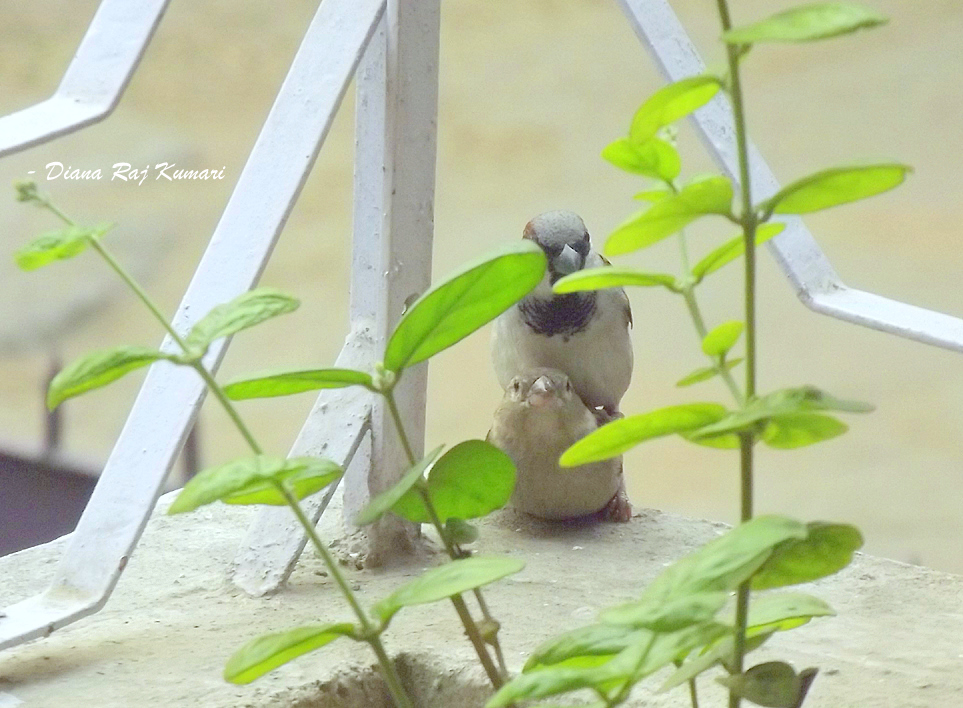


Let us spare the Sparrows and conserve these dwindling species. The conservation of the house sparrow and its habitat will not only save much of the common biodiversity but provide a better environment for other bird species, too. Best wishes to all who are striving to save the Sparrows.
---- Diana Raj Kumari ---
Diana Raj Kumari Photography: Beautiful moments of Spring!!
Diana Raj Kumari Photography: Beautiful moments of Spring!!: Songs of birds, new green leaves, flowers in bloom...everything about Spring is so beautiful!! *** ...
Friday, February 17, 2012
Silver Pheasant
The Silver Pheasant (Lophura nycthemera) is a species of pheasant found in forests, mainly in mountains, of mainland Southeast Asia and eastern and southern China, with introduced populations in Hawaii and various locations in the US mainland. It is also very closely related to the Kaliji Pheasant with which it can easily hybridize. The male is black and white, while the female is mainly brown.There are fifteen subspecies of Silver Pheasant, distributed from east Myanmar, Cambodia, Laos, Thailand, Vietnam, China to the island of Hainan. Widespread and common in most of its ranges, the Silver Pheasant is evaluated as Least Concern on the IUCN Red List of Threatened Species.

The Male Silver Pheasant is a striking bird. It is a beautiful large, up to 125cm, white pheasant with the bottom half being glossy black while the top half being white laced in black with long patterned tail. Has got bare red facial skin and also has a long bushy black crest adorning his crown which lies backwards across the head rather than vertical. It needs at least two years to attain full male plumage.
The Female happens to be olive brown with black-tipped crest although this is not as big as the one on the male and is brown with black at the tip. The Hen has some black & white streaking on her underparts. The True Silvers are larger than the other subspecies and the tail is longer. The male weighs 3 - 4 lbs (approx. 1.3 - 1.8kg) and the hen around 2.5 lbs (1-1.2kg).Silver pheasants enjoy a mixed diet similar to other birds. They like fruit and enjoy a variety of live food. They will tuck into crickets, spiders, locusts and waxworms as well as the usual mealworms.Silver Pheasants are polygynous in the wild and are sometimes kept with a few hens to one cock in captivity. Silver pheasants should be kept in an aviary at least 200 square feet. This will need to be larger for more than three birds.
It will breed from two years old and are also in full colour by this time. The hen will lay a clutch of 6 - 12 eggs but can continue laying up to as many as 30 - 40 eggs if they are removed from her nest which is a hollow scraped in the ground.
Chicks are easy to raise. They feed well, only occasionally needing encouragement to start eating their crumb. They have also been quite amicable with other chicks and easily become tame. This is indeed a beautiful bird.
*** Diana Raj Kumari ***
Subscribe to:
Posts (Atom)